Monday, December 8, 2014

The Complex Subject of Blowhards: Case Study in Crankiness

Has it not crossed Jeffrey Shallit's mind that Phillip Johnson is aware of those examples but doesn't find the case for the intermediate or transitional nature of those fossils very convincing?  -- Jonathan M. on Shallit's claim that Phillip Johnson lied about the fossil record 
Some notions of information are more closely tied to the Shannon notion of information (e.g. Thomas Schneider and Richard Dawkins) and tend not to wander much further. Much more closely related to some notion of meaning/function has been the Kolmogorov notion of information, also known as Kolmogorov complexity.  Complexity and information tend to be closely related notions; both are related to probability, and probability has a combinatorial nature.  The idea of mutual information is closely related to that of conditional probability.  A complex thing generally needs more information to describe it (or information and time, but that will have to wait), while a much simpler thing generally required much less information.  Highly improbable things tend to have many levels of contingencies, and convoluted  histories/developments. Optimal codes match less probable events to more bits of information.  An optimal code will tend to not only maximize the Shannon complexity of the messages but to also make the messages more compressed (maximizing K complexity per message length).

Jeffrey Shallit has become something of a public figure, not for math or computer science per se, but for being a "science defender" of the quixotic "anticreationist" variety. (Note: I have noticed Shallit also uses the term "anticreationist," though not in the ironic sense that I do.)  He has made a name for himself ridiculing ideas and the people who promote them.  He has complained in the past that 'specified complexity' would be better off called 'specified improbability.'  His and Elsberry's long critique of the idea of  'complex specified information' scoffs at the difficulty in reducing CSI neatly to one of the two kinds of information . (Everything else is "creationist information.") Winston Ewert's notion of algorithmic specified complexity is very closely related to Dembski's notions of CSI and is itself a specie of randomness deficiency, combining notions of K-complexity and probability.

Something that is ubiquitous among complexity theorists and attempts to quantify 'biological information' is notably absent from Shallit's writings on the topic of complexity.  It's what Jim Crutchfield calls 'humpology'.  Most of the attempts over the last 20 years have tried to distinguish 'useful' information/complexity from both highly ordered and highly disordered configurations.  Kolmogorov information considers highly disordered configurations to be provide more information, but most complexity theory tries to distinguish between useful information (what engineers typically mean by 'information': semantically "rich" information that carries some deep patterns) and the information maximized by total randomness.  This fundamental concern in complexity theory doesn't seem to concern Shallit at all (which is odd given reasons that we'll get to).

Sunday, December 7, 2014

save

Has it not crossed Jeffrey Shallit's mind that Phillip Johnson is aware of those examples but doesn't find the case for the intermediate or transitional nature of those fossils very convincing?  -- Jonathan M. on Shallit's claim that Phillip Johnson lied about the fossil record 

Saturday, December 6, 2014

the magic ratio


http://www.evolutionnews.org/2009/10/jonathan_wells_hits_an_evoluti026791.html
http://recursed.blogspot.com/2009/01/test-your-knowledge-of-information.html

"Does it take more or less genetic information to grow forelimbs into functional wings, than into manipulatory appendages?"

This was going around on PT for a while and I was tinkering with it a bit. What I think is being asked is: "Is there a magic ratio of functionality to the number of bits required to implement it?"

http://www.evolutionnews.org/2007/09/dr_shallit_takes_the_fifth004240.html

Friday, December 5, 2014

list of complexity measures

From William Dembski's post about Jeffrey Shallit's nitpicks about information--the relationship between information and complexity is a lengthier subject--Seth Lloyd's non-exhaustive list of complexity measures:  


Wednesday, December 3, 2014

Is "Darwinism" a made-up term?

One of the many double messages one gets about evolution:
  1. Evolution is so much bigger (and more robust!) than Darwinism.  Dawkins is a Darwinist but I'm not.  
  2. By Darwinism, you mean "Biology." "Darwinism" is a propaganda term invented by creationists.
It's possible that (2) is more likely to be espoused by educators and lobbyists than researchers.  Richard Dawkins and Paul Gross probably exemplify (2).  Off the top of my head, Larry Moran (Sandwalk), James Shapiro, Lynn Margulis, Rudolf Raff, and the Alternberg 16 scientists own to (1), although for some of them (1) might simply mean that there is more than one mechanism even though adaptation through selection is still the primary explanation for functional information (since selection depends far less on serendipity).   

But the problem is exemplified in the recent Nature article in which biologists disagree about whether evolutionary biology is in great need of re-conception.  

Depending on which biologist you ask, attacking selection is either attacking a straw man or attacking an unassailable, unquestionable foundation of biology.  Point out this contradiction and the various factions will rally and point out that they all believe in evolution (cue "Book of Mormon" song "I Believe") and they all believe selection is important.  Just in case the "non-existent" controversy "gives aid and comfort" to the Enemy.   

I'll end with this bit of think-of-the-children-ism from secular evangelist Bill Nye:
And I say to the grownups, if you want to deny evolution and live in your world that's completely inconsistent with everything we observe in the universe, that's fine.  But don't make your kids do it because we need them.  We need scientifically literate voters and taxpayers for the future. We need engineers that can build stuff, solve problems.
We need your kids to think like us.  Because engineers can't build stuff without the narrative speculations of evolutionary biology. (See Salem hypothesis)


Monday, December 1, 2014

The Shallit Affair: Defeated at Waterloo

Filed under "responses so juvenile that only very learned men will attempt them":

Why, I'll decide which ideas get heard!
     I arrived at the university [Waterloo] to give my talk on 2013 November 28. I had never met Shallit, but I recognized him from the picture beside his blog. Just before starting my talk, I said “I'm surprised to see you here.”, to which he replied “I could use a laugh.”. I got no further than halfway down my first slide, having made one definition, when Shallit spoke up. He said that I had already gone wrong, and that there's no point in continuing. I replied that I am just starting to present the standard incomputability argument, and I haven't yet begun to talk about the problems with it. Shallit said that my version of the Halting Problem is nonstandard and faulty, and repeated that there's no point in continuing. I tried to continue, but Shallit would not allow me to. Other members of the audience joined the fight, all arguing against Shallit, saying that he should let me continue, and save his objections to the end. After that shaky start, having lost valuable time, I completed most of my talk and asked for questions. Shallit left.
     On 2013 December 3, Shallit sent me an email saying that he had figured out where I went wrong, and how to set me straight.
  - Eric Hehner, "The Shallit Affair"
Dr. Shallit was hoping to give new meaning to "Halting Problem," it seems.  

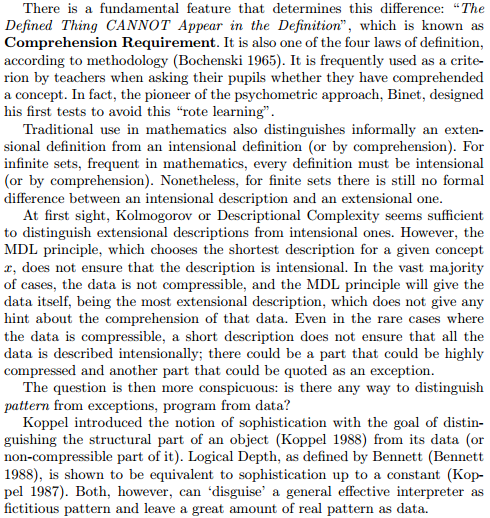
Comprehension and pattern vs. exception

signal/noise, program/data, regularities/randomness, pattern/exception...

From "Beyond the Turing Test" (page 8)

 
General zip utilities tend to overlook real pattern as well.  Is it possible that sophistication overlooks real structure because there aren't enough examples?  Effective complexity is simply an approximation for what would be the real pattern in the data.