


Oh, Paul Davies, you secular creationist, you!
"Any living thing possesses an enormous amount of ‘intelligence’… Today, this 'intelligence' is called 'information,' but it is still the same thing ... This ‘intelligence’ is the sine qua non of life. If absent, no living being is imaginable. Where does it come from? This is a problem which concerns both biologists and philosophers, and, at present, science seems incapable of solving it."
- Pierre-Paul Grassé, Evolution of Living Organisms, 1977
In reality, we already know that there is nothing in biology that is inconsistent with physics, chemistry and mathematics. In one of the most fundamental biological experiments in the twentieth century, Harold Morowitz and colleagues took cysts of the complex multicellular brine shrimp Artemia down to 2.2 degrees Kelvin (less than –270 °C), left them for six days, then slowly warmed them to room temperature, where they revived, grew and reproduced. At such low temperatures, information on energy levels, positions and velocities of electrons is lost; the only information left is about the chemicals and their relative positions. This tells us (as discussed in Penny D (2005) Biol Philos 20: in the press) that the composition and organization of chemicals is all that is required for a system to be alive. [emphases mine]The composition and organization of the biochemical machinery in the cells is the embodiment of information. Information that is independent of the energy levels, positions, and velocities of electrons, much as would have been predicted by Polanyi's "Life's Irreducibility." Polanyi agreed that life was not inconsistent with physics and chemistry--but it wasn't explained by them. Aside from the insight of the experiment (as opposed to the lesson drawn by Penny), the reductionist fallacy is unhelpful:
The low-level information of particular particles turns out to be unnecessary for the organism to recover its machine-like thermodynamic process.
___________________________________________
Therefore, organization is sufficient for life.
 Life can be suspended, therefore it is limited to a particular kind of organization (the kind that is presumably measurable). Reminds me of the reasoning that missed the early discovery of vitamin D. If a human being could be frozen in the same way, would that mean that there is nothing more to persons than their observable structure? Organization could be sufficient for the simplest examples of life. Or not. But the reasoning seems terribly flawed and overweening. Non-simulated "artificial life" has always involved already living cells.
 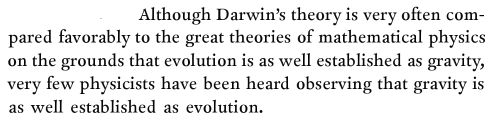 |
| David Berlinski, The Devil's Delusion, p. 191 |
In science's pecking order, evolutionary biology lurks somewhere near the bottom, far closer to phrenology than to physics. For evolutionary biology is a historical science, laden with history's inevitable imponderables. We evolutionary biologists cannot generate a Cretaceous Park to observe exactly what killed the dinosaurs; and, unlike "harder" scientists, we usually cannot resolve issues with a simple experiment, such as adding tube A to tube B and noting the color of the mixture.But wait, hasn't the academic
"While the great majority of biologists would probably agree with Theodosius Dobzhansky's dictum that 'nothing in biology makes sense except in the light of evolution,' most can conduct their work quite happily without particular reference to evolutionary ideas," A.S. Wilkins, editor of the journal BioEssays, wrote in 2000. "Evolution would appear to be the indispensable unifying idea and, at the same time, a highly superfluous one." I would tend to agree. Certainly, my own research with antibiotics during World War II received no guidance from insights provided by Darwinian evolution. Nor did Alexander Fleming's discovery of bacterial inhibition by penicillin. I recently asked more than 70 eminent researchers if they would have done their work differently if they had thought Darwin's theory was wrong. The responses were all the same: No.
I also examined the outstanding biodiscoveries of the past century: the discovery of the double helix; the characterization of the ribosome; the mapping of genomes; research on medications and drug reactions; improvements in food production and sanitation; the development of new surgeries; and others. I even queried biologists working in areas where one would expect the Darwinian paradigm to have most benefited research, such as the emergence of resistance to antibiotics and pesticides. Here, as elsewhere, I found that Darwin's theory had provided no discernible guidance, but was brought in, after the breakthroughs, as an interesting narrative gloss.
Has it not crossed Jeffrey Shallit's mind that Phillip Johnson is aware of those examples but doesn't find the case for the intermediate or transitional nature of those fossils very convincing? -- Jonathan M. on Shallit's claim that Phillip Johnson lied about the fossil recordSome notions of information are more closely tied to the Shannon notion of information (e.g. Thomas Schneider and Richard Dawkins) and tend not to wander much further. Much more closely related to some notion of meaning/function has been the Kolmogorov notion of information, also known as Kolmogorov complexity. Complexity and information tend to be closely related notions; both are related to probability, and probability has a combinatorial nature. The idea of mutual information is closely related to that of conditional probability. A complex thing generally needs more information to describe it (or information and time, but that will have to wait), while a much simpler thing generally required much less information. Highly improbable things tend to have many levels of contingencies, and convoluted histories/developments. Optimal codes match less probable events to more bits of information. An optimal code will tend to not only maximize the Shannon complexity of the messages but to also make the messages more compressed (maximizing K complexity per message length).
Has it not crossed Jeffrey Shallit's mind that Phillip Johnson is aware of those examples but doesn't find the case for the intermediate or transitional nature of those fossils very convincing? -- Jonathan M. on Shallit's claim that Phillip Johnson lied about the fossil record
