Showing posts with label secular creationism. Show all posts

Sunday, August 16, 2015

Jerry Coyne Demonstrates the Real Power of Selection

Jerry looking very evolved.
Just a quick post here, since it is too easy to dig deeply into these silly exercises of Coynage, but Jerry Coyne wrote a blog post in response to an email from Paul Nelson discussing the limits of natural selection as the explanatory show pony of the evolutionary circus, citing the work of various biologists.

Coyne frames this a "McLuhan moment" (Annie Hall reference) since he is such a big mucky-muck in the speculative science of squishy things that, unlike the Woody Allen character, he can in real life pull these great biologists "from behind the sign" and have them comment on whether Nelson understands their fine work.

But first, the relevant claim by Paul Nelson:
So when you [Jerry Coyne] tell your WEIT audience that natural selection is the only game in town for building complex adaptations, . . .  Readers who already know about the thinking of workers such as Eric Davidson, Michael Lynch, Andreas Wagner, John Gerhart & Marc Kirschner, or Scott Gilbert (all of whom, among many others, have recently expressed frank doubts about selection) must discount what you say about the centrality of natural selection to evolutionary theory . . .
To sum up, even though Coyne hollers loud and long that natural selection is the central, driving, omnipotent core of evolution, various noted biologists have "frank doubts" about the centrality of natural selection and/or unrestricted appeals to its creative power--specifically relevant to the alleged claim of Coyne (which he appears not to deny) that selection is by-and-large omnipotent and all-sufficient even if there are other evolutionary processes interfering along the way.  This counter-claim by Nelson is what Coyne will supposedly debunk.

Monday, August 10, 2015

Freeman Dyson, also a Secular Creationist

Freeman Dyson is a Christian in the same way that many Jewish people practice their religious traditions without believing their scriptures:
I am a practicing Christian but not a believing Christian. To me, to worship God means to recognize that mind and intelligence are woven into the fabric of our universe in a way that altogether surpasses our comprehension.
His point of view seems comparable to Paul Davies', Michael Denton's, Thomas Nagel's, and Rupert Sheldrake.


Watch it there, Freeman.  You are officially a secular creationist.  And a crank.


Tuesday, June 30, 2015

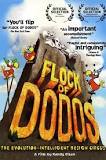
Randy Olson's Flock of Nonsense (Update on John Angus Campbell)

Well, it seemed like it was time to link all these Flock of Dodos write-ups of yesteryear in one place.
To sum it up, Olson's unprofessional (and unethical, I think, as a documentarian) treatment of John Angus Campbell, Jonathan Wells, John Calvert, and Michael Behe, either in the film or in the "Pulled Punches" follow-up, marks the film as schlockumentary.  Olson highlights some matters as essential that he is later free to dismiss as trivial when he's shown to be wrong.

In other words he engages in the very thing he defines as "Trivia Tackling": "trying to take down a large institution, idea or individual, not by assailing the large and significant parts, but by doggedly locking on to pieces of trivia."  The closest thing to "assailing the large and significant parts" in Flock is when he talks briefly about Behe's mousetrap analogy.  We see no intense discussion between Olson and Behe about the mousetrap, which would have been interesting, nor about any evolutionary matter with Behe that Olson has any expertise.

Something I noted recently is that John Angus Campbell (the "fake" Darwinist in the film) has his own website in which he clarifies his beliefs and his position on ID, and how Wikipedia mischaracterizes him.  He is politically liberal, and a subscriber to neo-Darwinism who has long advocated "teaching the controversy."  He ended his association with Discovery Institute when he started to find himself in the cross-hairs of Discovery Institute's political enemies.
When Wikipedia and The Weekly [a tabloid] mistakenly assumed I was supporting ID (and the religious right!) rather than promoting argument as a way of engaging a classic text [Darwin's Origin] - (and this before audiences who particularly needed to read it) the DI [Discovery Institute] affiliation had outlived its usefulness [for what?] and it was time for me to move on.*
Like Kenny Rogers, Campbell knew when to fold 'em, when to walk away, when to run.  Congratulations, Campbell. You too are a "secular creationist" for aiding and abetting "anti-science."  Question: Did Randy Olson consult anything other than Wikipedia to learn about Campbell?

See Campbell's concise rebuttal to Wikipedia and the Seattle Weekly:


.

Tuesday, September 23, 2014

Secular creationism on the rise in molecular biology!


From Jerry Coyne [emphasis mine]:
Virtually all of the non-creationist opposition to the modern theory of evolution, and all of the minimal approbation of [Coyne's University of Chicago colleague James] Shapiro's views, come from molecular biologists. I'm not sure whether there's something about that discipline (the complexity of molecular mechanisms?) that makes people doubt the efficacy of natural selection, or whether it's simply that many molecular biologists don't get a good grounding in evolutionary biology.
LOL   

(I thought I heard for the last 15 years that evolutionary theory was molecular biology...)

I guess these molecular biologists are ... SECULAR CREATIONISTS!

Thursday, October 3, 2013

Lynn Margulis is a secular creationist too!

Jerry Coyne goes all anticreationist in branding Lynn Margulis as a secular creationist.

Coyne disapproves of Margulis's book Acquiring Genomes, to make an understaement, but what seems to have earned his disapproval is simply that Margulis' saw any need for any explanation.  In order for her to see any explanatory gap (Altenburg 16, anyone?), she had to be completely ignorant of all the advances in evolutionary speculation over the last 30 years.

You don't need to look any further, of course, than the title of the article:  By "dissing" neo-Darwinism, Margulis has dissed evolution.  Typical anticreationist fare.

Once again, macroevolution is a simple consequence of population genetics, not so simple that one has to be knowledgeable about a great many articles (the very many exciting scholarship to which Coyne alludes) in order to appreciate just how macroevolution has been explained to the satisfaction of neo-Darwinists.

Coyne seems to have missed (or "dissed") that Margulis' endosymbiotic theory ideas have caught on and become much more mainstream in evolutionary science.  If, as recent and sketchy jurisprudence has it, science is what scientists do, Margulis' "crazy" ideas, as he puts it, have wormed their way into science without his approval.  The explanatory gap is illusory, in Coyne's opinion.

Personally, I think there are some serious problems with Margulis' ideas with regard to the specific explanandum of generating novelty, but I believe she's very right about the explanatory gap:
This is the issue I have with neo-Darwinists: They teach that what is generating novelty is the accumulation of random mutations in DNA, in a direction set by natural selection. If you want bigger eggs, you keep selecting the hens that are laying the biggest eggs, and you get bigger and bigger eggs. But you also get hens with defective feathers and wobbly legs. Natural selection eliminates and maybe maintains, but it doesn’t create.
After quoting the above, Coyne completely dances around Margulis' insight that selection is severely constrained and that natural selection is not omnipotent.

Coyne also defends his old friend Richard Lewontin. I think it may well be possible that Margulis remembers Lewontin's words in a more unflattering light than he said them (and I don't see a complete retraction there from Lewontin) but I think Lewontin more than likely said something akin to what Richard Feynman recounts in his Cargo Cult Science speech:
For example, I was a little surprised when I was talking to a friend who was going to go on the radio. He does work on cosmology and astronomy, and he wondered how he would explain what the applications of his work were. "Well," I said, "there aren't any." He said, "Yes, but then we won't get support for more research of this kind." I think that's kind of dishonest. If you're representing yourself as a scientist, then you should explain to the layman what you're doing-- and if they don't support you under those circumstances, then that's their decision.
Unlike Feynman's friend, Margulis did not claim that Lewontin mischaracterized his work but was honest about it.  Lewontin has since clarified that Margulis' recollection made it sound like Lewontin's work with disappointing formulas was so he could get grant money for himself where as it was to get money to “run an institution”: to “fund a group of creative people to do what they want.”  Once again the selfish gene has led to altruism.  I think maybe Coyne's overstated umbrage over Lewontin's alleged hucksterism disguises that he is reacting to Margulis getting dangerously close to the fact that there is big money in overflated claims of what has actually been explained, and neo-Darwinism has been a TROUGH.

Are all the papers on evolutionary biology written by hobbyists?  It takes money for people to spend their working life speculating on historical contingencies of how one organism changed into another during such and such an epoch and speculating on what natural selection may explain.  Whence cometh the money?   How might the money flow be affected by perceptions that evolutionary biology might be making popular evolutionary views more elaborate and more consistent with what it known about how organisms work, but not necessarily deepening our understanding of how organisms work?  Once you stop defining the deepening of knowledge in terms of refining "biology's unifying principle," it may be that our understanding is actually being stunted by so much number-crunching in the service of idle speculation.

I'll add here that Jerry Coyne also has a beef with secular creationist Mary Midgely, and anyone who undermines the popular credibility of the Modern Synthesis.  So if you want to know how the Modern Synthesis is falling apart, find out what Bilbo Baggins, er... I mean, Jerry Coyne hates.  Look up all the people he tries to discredit, and you will have an idea what's going on.   In tune with Thomas Nagel's "dangerous sympathy" for Darwin skeptics, Coyne thinks that Margulis may be "worse for science than creationists [Coyne probably has ID proponents in mind here], since her scientific credibility remains high." Actually, an anticreationist usually doesn't mind people doubting Darwinism as long as (a) they are in the minority (among tax-payers and grant-funders) and (b) they can all be denied "scientific credibility."  

Tuesday, October 1, 2013

Anticreationism from Stephen Jay Gould

In his Non-Overlapping Magisteria (I can't help but think of this phrase when watching The Golden Compass) Stephen Jay Gould claims "creationism" -- and one naturally thinks he has in mind specifically what he heroically opposed in McLean vs. Arkansas -- "a splinter movement (unfortunately rather more of a beam these days) of Protestant fundamentalists who believe that every word of the Bible must be literally true."

Phillip Johnson considered this proposed treaty between "magisteria" as disingenuous.  While I won't speculate here about Gould's motives, I do think most of the reasoning behind the idea of non-overlapping magisteria (which despite Gould's framing of the problem surely wasn't first thought of by him) does seem a little disingenuous to me.

More importantly though, you'll notice that whomever the initial supporters/advocates were in this land where Protestant fundamentalism is more than a mere footnote in its history, ID advocates (including those that advocate against this outlawing of ID) include more than Protestant fundamentalists.  As far as I know, neither Michael Behe nor Jonathan Wells nor David Berlinski nor David Klinghoffer nor Richard Sternberg are Protestant fundamentalists.

It's important to realize, however, that anticreationists believe that if the intelligent design movement evolved out of the creation science movement to any significant degree (Of Pandas and People is the important missing link fossil for the Barbara Forrests) then it has to classified as the same movement with the same pros and cons, the same limitations and problems, with all the same ideological grounds.   All one has to do is look into Eugenie Scott's treatment of Richard Sternberg to see this.  Or to look into the latest edition of Why People Believe Weird Things to see how Michael Shermer has updated his section on creationism to mention "intelligent design" as a new form of creationism and most of his criticisms of creationism have no bearing at all on intelligent design.  (I believe the ones that do have some sort of bearing are --as stated--strawman arguments or weakly applied to ID, but they could at least be developed in some way; the others are complete non sequiturs.)  But it's important to take evolutionist Michael Behe and pin a Duane Gish nametag to his chest and continue the debate from there.

Otherwise, what is the point of trying to discredit intelligent design with the guilt by association argument.  Association with Protestant fundamentalism.  If most people who find the courage to speak out against a sketchy scientific program -- in the face of great risk to their careers -- happen to do so because of a matter of faith, why does that become legal grounds for invalidating a cause?
Justice Scalia has a reputation for throwing attorneys off-balance with elaborate hypothetical questions. True to form, he posed for Topkis a long hypothetical question—for the purpose, presumably, of demonstrating that a law could have a religious motivation and yet be constitutional. “Let’s assume,” he began, “that there is an ancient history professor…who has been teaching that the Roman Empire did not extend to the southern shore of the Mediterranean in the first century A.D. And let’s assume a group of Protestants who are concerned about that fact, inasmuch as it makes it seem that the Biblical story of the crucifixion has [the] thing a bit wrong.” Concluding his story, Scalia tells Topkis that the upset students march “to the principal of the school, and say, ‘This history teacher is teaching what is just falsehood.’ And the principal says, ‘Gee, you’re right.’ And he goes and directs the teacher to teach that Rome was on the southern shore of the Mediterranean in the first century A.D.” The principal’s order was “clearly” religiously motivated, Scalia asserted, but wouldn’t it also, he asked, be constitutional?
Sometimes the only ones that will put up much of a fight are those who have a big stake in the outcome.  In spite of our First Amendment (and ironically, using an odd interpretation of it), those who have such a stake are often denied a voice precisely because of that stake.  Hmmm.

I think skepticism against Darwinism is nonetheless gaining momentum outside the Protestant faithful.  Thomas Nagel, a leading atheist philosopher, has joined the ranks of the secular creationists:
I realize that such doubts [about Darwinian naturalism] will strike many people as outrageous, but that is because almost everyone in our secular culture has been browbeaten into regarding the reductive research program as sacrosanct, on the ground that anything else would not be science.
No kidding.  In his Mind and Cosmos: Why the Materialist Neo-Darwinian Conception of Nature is Almost Certainly False, Nagel has joined this mystical splinter cult of Protestant fundamentalism. He's even made given a "pernicious" and "dangerous" commendation to some of the intelligent design advocates at Discovery Institute.  One of the many who pretend to not be a Protestant fundamentalist in order to "mainstream" a thinly disguised form of Biblical literalism.

Can you say "bugaboo," kids?  I knew you could.  

PS:
Coyne also bizarrely characterizes Berlinski as a “creationist,” and a “defender” of Intelligent Design theory. In fact, he is neither. The notion that Berlinski is a “creationist” is nothing short of laughable and while “sympathetic” to ID, he is by no means an advocate of the theory, much to the chagrin of his colleagues at the Discovery Institute. 
Moshe Averick


Wednesday, September 25, 2013

Colin Patterson questions biologists on evolution

Colin Patterson's question to biologists:
...I mentioned a question ('Can you tell me anything you know about evolution?') that I have put to various biologists, and an answer that had been given: 'I know that evolution generates hierarchy.' In the framework of phylogenetic reconstruction and our current problems with it, another answer comes to mind: 'I know that evolution generates homoplasy' [or "convergence," in the older jargon of systematics]. In both cases, the answer is not quite accurate. It would be truer to say, 'I know that evolution explains hierarchy' or 'I know that evolution explains homoplasy.' We must remember the distinction between the cart--the explanation--and the horse--the data. And where models are introduced in phylogenetic reconstruction, we should prefer models dictated by features of the data to models derived from explanatory theories.
Careful there, Patterson.  You are starting to sound like a secular creationist.

Saturday, August 31, 2013

Michael Ruse States Why Darwin Should Not Be Publicly Challenged

Suzan Mazur, who wrote about the Altenberg 16 conference on the "Extended Synthesis," posted an e-mail chain conversation at her site: "From October 16 – 24, 2007, [Stanley] Salthe ran an email chain on the [Jerry] Fodor “Pigs” story with some of the science elites throwing in their two cents."

Said Stan Salthe:
“Folks – There’s not much new in this below, but, given Fodor’s prominence, and the place of publication, I thought I would pass it on.”
Michael Ruse, philosopher:
“In my opinion Fodor’s piece is grotesquely and immorally irresponsible – he has done no homework on evolutionary theory – to say that natural selection did not shape the guppy and the fruitfly is ludicrous of course, every creationist in north america is salivating today – even though, they are the people who push adaptation more than even me! think that this one won’t be used in the argument over what should be taught in schools?
Today, I am deeply ashamed to be a philosopher”
Stuart Newman, cell biologist:
“Fodor’s piece seems pretty reasonable to me, in fact, kind of obvious. To say that organisms at any stage of evolution have only a limited array of condition-dependent inherent characteristics, or developmental pathways, and selection can do no more than choose among these, has nothing whatsoever to do with creationism.”
Michael Ruse:
“You are very naive – it has everything to do with creationism – of course, to deny adaptationism is not to endorse creationism – but to write a piece slagging off natural selection in that way, is to give a piece of candy to the creationists – I am sure that duane gish has already incorporated this into his talks of course natural selection has to work on an array of given things, but this is not to deny selection – especially not through fodor’s silly arguments about analogies – and certainly not adaptationism the point of course is that fodor did not simply write a technical piece on adaptation – he wrote a piece flamboyantly denying selection in today’s climate, where we have just had two ultra right supreme court justices appointed, I think his behavior is somewhere between stupid and wicked
Emphases are mine. ... Apparently, Supreme Court justices who elect to not dictate to the states what is and isn't science might not agree with Judge Jones' schlocky philosophy of science and that makes them "ultra right."  Ruse has a moment here where he descends into "Duane Gish Syndrome."  Is he an anticreationist or a secular creationist? 

Saturday, August 24, 2013

Michael Ruse, Secular Creationist

Michael Ruse:
. . .  I think also in the present, for many evolutionists, evolution has functioned as something with elements which are, let us say, akin to being a secular religion. . . .  for Thomas Henry Huxley, I don't think there's any question but that evolution functioned, at a level, as a kind of secular religion. . . . I think Julian Huxley was certainly an atheist, but he was at the same time a kind of neo-vitalist, and he bound this up with his science. . . . it comes through very strongly that for Julian Huxley evolution was functioning as a kind of secular religion.  . . . I'm just saying this in a matter-of-fact sense -- I think that today also, for more than one eminent evolutionist, evolution in a way functions as a kind of secular religion. . . . in On Human Nature, [E.O.] Wilson is quite categorical about wanting to see evolution as the new myth, and all sorts of language like this. That for him, at some level, it's functioning as a kind of metaphysical system.* 
The New Atheists seem to hate Michael Ruse's soft touchy-feely liberalism.  Of course, I don't buy into the  Non-Overlapping Magisteria (NOMA) of Gould and Ruse (which feeds the "safe religion" dogma) much more than the idea that science and religion are at odds.  In the typical double standard, what we have in our universities is (a) pervasive preaching that religion is only safe if it has nothing to say about the nature of the universe, (b) pervasive eulogizing that science will die a painful death if scientific results can be used to imply non-material or extra-scientific causes, and (c) pervasive commentary on how science has liberated us from our silly superstitions about deity.

The Pharisees and Sadducees in the anti-creationist camp aren't always closing ranks.  I think anticreationism is a good name for the shared enthusiasm, in spite of the fact that the conflation of creationism with intelligent design is a ugly bit of equivocation, since it seems to be based on a fear of creationism being taken seriously.  No doubt, the usual suspects would say that I am tacitly agreeing with their conflation of ID with creation science and Young Earth creationism.  Rather, I am thinking of anticreationism as a sort of hysteria over the creationist bugbear that
(a) causes the afflicted to react against anything that threatens the authoritarian control of a scientific hierarchy, and
(b) causes the afflicted to respond to almost anyone (e.g. Rupert Sheldrake or David Berlinski) suggesting that science can point to non-material causes as though he or she were a creationist like Duane Gish.  (I also think of this as "Duane Gish syndrome.")

Ruse with trilobite tattoo
This is related to the habit of Dawkins, Prothero, and Eugenie Scott of being seemingly incapable of responding to anything other than Young Earth Creationism.  To Dawkins, David Berlinski is a creationist; to Prothero, Stephen Meyer is arguing based on the Book of Genesis; to Scott, if Dr. Rick v. Sternberg's neo-Platonism allows him to seriously critique baraminology, he might as well be a creationist -- after all "if it walks like a duck, and quacks like a duck ..."

Which puts me in mind of David Sloane Wilson saying that Jerry Fodor deserved the title of "secular creationist" (a term slightly less absurd than "creationist porn") for suggesting that science is not a prescriptive for the human condition.  Apparently, for Wilson whatever lies outside of Scientism is Creationism.

Perhaps we will have a repeat of the "Science Wars."  The New Atheists seem to hate Michael Ruse's soft liberalism, in spite of Ruse's complicity in the Edwards vs. Aguilard jurisprudence, a victory that atheists, materialists, secular humanists, positivists, and various anti-supernaturalists have managed to marshal against any attack on Darwinism ever since Judge Jones cut-n-pasted the ACLU's amicus brief into his ruling.  In spite of being an "ardent Darwinian," Ruse is apparently too postmodern for Positivism's heirs.

In a pettiness that seems to typify the New Atheists, Jerry Coyne slams Michael Ruse for identifying the wrong Hitchens brother (in fact, he desperately screencaps Ruse's mistake in case Ruse notices the obvious error--which he does).  For Coyne, this is the telling proof that Ruse is hopelessly confused.  Well, the first bit anyway.  Like Jeffrey Shallit obsessing over Schopenhauer attributions, Coyne takes Ruse to task over using the popular inaccurate version of the George Orwell quote: “There are some ideas so absurd that only an intellectual could believe them.” Coyne loves the original: “This is one of those views which are so absurd that only very learned men could possibly adopt them.”  Sadly, Coyne wasn't using the the Orwell quote to refer to neo-Darwinism or the New Atheist caricature of religious history.

Come to think of it, this also reminds me of a truly bizarre response that Daniel Dennett submitted for an article by David Berlinsky.  It was a bunch of random, excited pettiness bordering on schoolyard bullying, among other things focusing on Berlinsky's mistake with a gender pronoun (not making this up) and unwittingly revealed his own ignorance over the term "combinatorial explosion."  Berlinksy aptly called the response "a robust display of vulgarity."  I think Dennett is capable of much better, and it would be a kindness to attribute that outburst to something written during a drunken rage.

Then again, maybe there are responses so juvenile that only very learned men will attempt them.

Anyway, after Coyne gets through with the minor kvetches (not so minor that he doesn't assign them ordinal numbers for reference), he has used up all his energy educating us on the particulars of names and quotes that he waves his hands and leaves the humanism/atheism divide as an exercise to the reader.  He quotes a rather well-stated criticism from Ruse and focuses on the first word of the excerpt.  I'll fill in the blanks. You can be an atheist without bothering with the "human reason, ethics, social justice" that secular humanists attempt to incorporate into their view.  However, the New Atheists and the Secular Humanists seem to be pretty much on the same page with respect to what Ruse is saying in the quoted passage.  Coyne doesn't bother speaking to that, but dismisses Ruse on the basis of "Peter Hitchens," "Humanists," and a misquote.

Ruse earns enough contempt from Coyne as a bad sport that Coyne shies away from more name-calling, clearly sounding disappointed that Ruse doesn't appreciate the unprofessionalism.  PZ Myers is not so coddling, and wishes he had thought of "something better" (showing more contempt, presumably) to call Ruse than the 'clueless gobshite' he calls him.  To his credit Ruse has never called out Myers as an oozing pustule of rancor and absurdity.  One gets the impression reading Myers' response that he has no problem attributing both "[b]lind, unquestioning worship of our leaders" and "incessant fractiousness and dissension" to theistic religion, but considers it a great contradiction to say that, like theistic religion, either is true of the anti-religion complex of atheism, materialism, Scientism, "free thought," and secular humanism.  He doesn't correct Ruse on applying either description to theistic religion.

My guess is that what really irks Myers is that he doesn't like that Ruse is saying that people that hold to atheistic and materialistic worldviews often behave like fundamentalist proselytizers and that the American people have a legitimate interest in government schools not being used for such proselytizing  -- or at least, that the proselytizing not be so overt and obvious.  Eugenie Scott's response to Ruse on this score was that he was simply being "dumb." (To which he replied, "But while that may indeed be so, I am not sure that it is an argument."  I am quite sure it isn't, Michael.)

Are schools promoting a metaphysics of naturalism?  Are kids getting that picture from "the science" or from the way science is being taught?

Ruse acknowledges that what one finds compelling (or what kind of evidence one may be willing to admit) is guided by one's metaphysics:
But [Philip Johnson and I] did talk much more about the whole question of metaphysics, the whole question of philosophical bases. And what Johnson was arguing was that, at a certain level, the kind of position of a person like myself, an evolutionist, is metaphysically biased at some level, just as much as the kind of position of let us say somebody, some creationist, someone like [Duane] Gish or somebody like that. And to a certain extent, I must confess, in the ten years since I performed ["performed"?], or I appeared, in the creationism trial in [Epperson vs.] Arkansas, I must say that I've been coming to this kind of position myself.*
Michael Ruse again:
. . .  I think also in the present, for many evolutionists, evolution has functioned as something with elements which are, let us say, akin to being a secular religion. . .  for Thomas Henry Huxley, I don't think there's any question but that evolution functioned, at a level, as a kind of secular religion. . . . I think Julian Huxley was certainly an atheist, but he was at the same time a kind of neo-vitalist, and he bound this up with his science. . . . it comes through very strongly that for Julian Huxley evolution was functioning as a kind of secular religion.  . . . I'm just saying this in a matter-of-fact sense -- I think that today also, for more than one eminent evolutionist, evolution in a way functions as a kind of secular religion. . . . in On Human Nature, [E.O.] Wilson is quite categorical about wanting to see evolution as the new myth, and all sorts of language like this. That for him, at some level, it's functioning as a kind of metaphysical system.*  
I think that the same postmodernist sympathies in Ruse that make him very interested in social constructivism in science also simply can't abide the idea that humans have some exalted status in the natural order.  Ruse (2010) expresses skepticism in Fodor and Piattelli-Palmarini's proudly professed atheism because he suspects that they "just cannot stomach the idea that humans might just be organisms, no better than the rest of the living world. " Maybe they are simply seeing what the "ancient mind" called "the image of God."   Hey, if it looks like a duck and walks like a duck ...

Is it ironic that Ruse is complaining that Coyne and his fellow ultra-Darwinian materialists are ripping on him for bucking against Scientism when Ruse's response to Jerry Fodor's similar transgression was to denounce Fodor as "wicked" for not realizing the possible ramifications of Darwin doubt on U.S. public policy?  (Ruse is a English conservaphobe at a Canadian school, mind you, in spite of the enormous role he has played in U.S. science politics.)

Is it ironic that Ruse can feel conflicted about having to censor his postmodern second-guessing of "science's" claim to ultimate truth because of the political implications, while publicly condemning Fodor for "giving creationists a piece of candy"?  Isn't this just one secular creationist crusading against another?

Epilogue:  I wrote "anticreationism" for the lack of a better word at the time.  I just noticed that this is a term that Ruse uses to describe the NCSE.*  I'll add here that I think Ruse is right to think that the New Atheists have put at risk (God bless 'em) the hitherto successful method of NOMA:  Religionists can go on claiming to know the meaning of life, and we scientists will decide what is real and what their children will be told is real.  (Sounds legit.)
That Pigliucci's accusations of conspiracy unwittingly extend to people on his own side constitutes, in my opinion, further evidence that his zeal against creationism (as understandable as it is) has generated in him an illegitimate negative bias against anything that is in any way associated with creationism.  Once again, I believe Pigliucci's strong dislike for creationism is well-founded, but it appears to have caused him to miss the point of The Design Inference, whether the point of the book turns out to be correct or incorrect.  - Mark Velutic [emphasis mine]