Showing posts with label Flock of Dodos. Show all posts

Tuesday, June 30, 2015

Randy Olson's Flock of Nonsense (Update on John Angus Campbell)

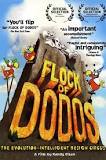
Well, it seemed like it was time to link all these Flock of Dodos write-ups of yesteryear in one place.
To sum it up, Olson's unprofessional (and unethical, I think, as a documentarian) treatment of John Angus Campbell, Jonathan Wells, John Calvert, and Michael Behe, either in the film or in the "Pulled Punches" follow-up, marks the film as schlockumentary.  Olson highlights some matters as essential that he is later free to dismiss as trivial when he's shown to be wrong.

In other words he engages in the very thing he defines as "Trivia Tackling": "trying to take down a large institution, idea or individual, not by assailing the large and significant parts, but by doggedly locking on to pieces of trivia."  The closest thing to "assailing the large and significant parts" in Flock is when he talks briefly about Behe's mousetrap analogy.  We see no intense discussion between Olson and Behe about the mousetrap, which would have been interesting, nor about any evolutionary matter with Behe that Olson has any expertise.

Something I noted recently is that John Angus Campbell (the "fake" Darwinist in the film) has his own website in which he clarifies his beliefs and his position on ID, and how Wikipedia mischaracterizes him.  He is politically liberal, and a subscriber to neo-Darwinism who has long advocated "teaching the controversy."  He ended his association with Discovery Institute when he started to find himself in the cross-hairs of Discovery Institute's political enemies.
When Wikipedia and The Weekly [a tabloid] mistakenly assumed I was supporting ID (and the religious right!) rather than promoting argument as a way of engaging a classic text [Darwin's Origin] - (and this before audiences who particularly needed to read it) the DI [Discovery Institute] affiliation had outlived its usefulness [for what?] and it was time for me to move on.*
Like Kenny Rogers, Campbell knew when to fold 'em, when to walk away, when to run.  Congratulations, Campbell. You too are a "secular creationist" for aiding and abetting "anti-science."  Question: Did Randy Olson consult anything other than Wikipedia to learn about Campbell?

See Campbell's concise rebuttal to Wikipedia and the Seattle Weekly:


.

Monday, December 8, 2014

The Complex Subject of Blowhards: Case Study in Crankiness

Has it not crossed Jeffrey Shallit's mind that Phillip Johnson is aware of those examples but doesn't find the case for the intermediate or transitional nature of those fossils very convincing?  -- Jonathan M. on Shallit's claim that Phillip Johnson lied about the fossil record 
Some notions of information are more closely tied to the Shannon notion of information (e.g. Thomas Schneider and Richard Dawkins) and tend not to wander much further. Much more closely related to some notion of meaning/function has been the Kolmogorov notion of information, also known as Kolmogorov complexity.  Complexity and information tend to be closely related notions; both are related to probability, and probability has a combinatorial nature.  The idea of mutual information is closely related to that of conditional probability.  A complex thing generally needs more information to describe it (or information and time, but that will have to wait), while a much simpler thing generally required much less information.  Highly improbable things tend to have many levels of contingencies, and convoluted  histories/developments. Optimal codes match less probable events to more bits of information.  An optimal code will tend to not only maximize the Shannon complexity of the messages but to also make the messages more compressed (maximizing K complexity per message length).

Jeffrey Shallit has become something of a public figure, not for math or computer science per se, but for being a "science defender" of the quixotic "anticreationist" variety. (Note: I have noticed Shallit also uses the term "anticreationist," though not in the ironic sense that I do.)  He has made a name for himself ridiculing ideas and the people who promote them.  He has complained in the past that 'specified complexity' would be better off called 'specified improbability.'  His and Elsberry's long critique of the idea of  'complex specified information' scoffs at the difficulty in reducing CSI neatly to one of the two kinds of information . (Everything else is "creationist information.") Winston Ewert's notion of algorithmic specified complexity is very closely related to Dembski's notions of CSI and is itself a specie of randomness deficiency, combining notions of K-complexity and probability.

Something that is ubiquitous among complexity theorists and attempts to quantify 'biological information' is notably absent from Shallit's writings on the topic of complexity.  It's what Jim Crutchfield calls 'humpology'.  Most of the attempts over the last 20 years have tried to distinguish 'useful' information/complexity from both highly ordered and highly disordered configurations.  Kolmogorov information considers highly disordered configurations to be provide more information, but most complexity theory tries to distinguish between useful information (what engineers typically mean by 'information': semantically "rich" information that carries some deep patterns) and the information maximized by total randomness.  This fundamental concern in complexity theory doesn't seem to concern Shallit at all (which is odd given reasons that we'll get to).

Monday, October 6, 2014

Questions about Flock of Dodos and Jonathan Wells

Olson essentially took off the gloves in response to an “attack” that was “launched” by Discovery Institute.  Olson’s use of one interviewee’s positive response about this seems as selective as his choice of “Icons” (i.e. Haeckel’s embryos) and his choice of interviewees with which to debate evolutionary “truths.”   Having talked personally (not an interview) with John Calvert, I can say you will not hear such a glowing review about fair representation.  Calvert says that Olson edited his interview with Calvert to tell a very different story about the search for Haeckel’s embryos than what actually took place.  In Flock there is a time lapse with Olson’s narration filling in the gap implying that Calvert was searching for the most recent textbook using Haeckel’s embryos and could only find it in a very old textbook, though Calvert intimates that it was a convenient source to show the pictures. Upon watching Flock  I was sure that I had seen Haeckel’s embryos twice (two different books by evo-devo biologists) just that month, but even in relatively short books I had a hard time finding the exact locations of the pictures, even while consulting the indices.  Illustrations recently viewed were hard to find even when I knew exactly which books to look in. Calvert thinks Olson was both unfair and disingenuous. 

Of course, the obvious question would be to next ask: “So just to clarify, you are saying that there are people around that remember George Washington?”  You have to wonder why Olson doesn’t ask for clarity on that point.   

Is Jonathan Wells in fact a "biologist"? Science Citation Index cites two abstracts (1995) which he coauthored. Ironically one is Molecular Biology of the Cell 6, 666. Clearly he's not currently an active research biologist. His educational goals were apologetic, not scientific. He's a minister in the Unification Church (a "Moonie" in popular culture, see home page). His goal in obtaining a biology Ph. D. was to discredit Darwinism rather than to understand biology. This is hardly scientific objectivity.

More motive-mongering.  Wells can’t be a biologist because he has the wrong motives.  I wonder how many of the 94% of bio PhDs who are atheists and/or agnostics consider “understanding biology” and “discrediting” intelligent design to not only be non-conflicting, but to be nearly synonymous.  How many consider “understanding biology” and “discrediting” theism to not only be non-conflicting but mutually reinforcing?  How many actively tell their students this?   They are a dime a dozen.   “Moonie” is not quite so neutral a term as “Mormon”— I doubt that any Unification follower would generally accept “Moonie”.  In their heyday, the Moonies were seen as yet another weird thing in the cultural upheaval of the 70s, and the heirs of positivism take delight in associating Wells with that epithet.  Wells can’t be a scientist: he’s a religious minister after all, and in one of them weird cults to boot. 

None of these champions for truth can take the man on his own terms. 

Sunday, September 21, 2014

Pulled Punches: Haeckel's Embryos in Peer Reviewed Literature

First I'll talk about the peer-reviewed literature that Randy Olson brings up, and then I'll bring up some peer-reviewed literature that contradicts him.

In Randy Olson's "Pulled Punches" extra for his Flock of Dodos, Olson references an article in The Quarterly Review of Biology ...  and mentions the "peer-reviewed" status of said journal to bolster his claims about Haeckel's embryos.  As I've expressed elsewhere, I find Olson's choice of this particular example (which he says he picked for personal reasons--presumably because he thought himself particularly knowledgeable on the subject) of that particular book (Icons of Evolution) to represent Intelligent Design to be a loaded choice.

The authors of Olson's touted article have been key figures in the neo-Darwinian public policy think tank NCSE (National Center for Science Education) which is dedicated to having neo-Darwinian theories and hypotheses taught uncritically, and to discrediting Intelligent Design by conflating it with creationism and by promoting ad hominem arguments, and which played a key role in the mistreatment of Richard Sternberg at the Smithsonian.  Kevin Padian in particular dislikes Wells' criticism of his dino-bird theories, even though Wells' criticism is probably tame compared to that of paleornithologist Dr. Alan Feduccia.

At any rate, Padian and Gishlik's article seems to claim that Wells did not publish research-based papers after getting his PhD nor did engage in any research, a claim contradicted by Carolyn Larabell.  The appearance of this spewing of "pro-science" blatherskite in Quarterly Review says more about the journal than it does about the article.  No amount of peer review can make a journal avoid libel, it seems.  Nor apologize for it.  The fact that Quarterly Review has become a haven for this level of attack on Jonathan Wells, an attack all the more cheapened by associating Dr. Wells with a fictional murderous con artist (in the title no less), demeans its status as a scholarly journal. Why haven't we heard about the Talented Mr. Richards and the Talented Mr. Gould?

It was not long after that creationists and advocates of intelligent design ignited thousands of websites in an electronic auto-de-fé wherein Haeckel's reputation and that of Darwinian theory were generally sacrificed to appease an angry God...

(Robert J. Richards, "Haeckel's embryos: fraud not proven," Biology & Philosophy, Vol. 24:147-154 (2009).)
http://www.evolutionnews.org/2012/10/darwin_lobbyist_1065151.html

Contrary to the evolutionary hourglass model, variations in the adult body plan are often foreshadowed by modifications of early development. ... These modifications of embryonic development are difficult to reconcile with the idea that most or all vertebrate clades pass through an embryonic stage that is highly resistant to evolutionary change. This idea is implicit in Haeckel's drawings...

http://www.evolutionnews.org/2007/05/a_reply_to_carl_zimmer_on_embr003597.html


Friday, September 19, 2014

Punches Pulled: Michael Behe Doesn't Care

In his "Punches Pulled" extra for his film Flock of Dodos, Randy Olson goes through a list of things that he left out of the film supposedly to be nice (i.e. to appear less hostile) rather than to keep his film from becoming a schlockumentary.

I direct your attention to his coup-de-gras.  He admits that he talked so long to Dr. Michael Behe that he felt tired afterward.  Tired?  Was there a debate that didn't make it into the film?  (He stresses in the film that two other interviewees he didn't debate about evolution because they didn't have the background.  Maybe he engaged Michael Behe about his then-forthcoming book Edge of Evolution, a book that discussed the powers of mutation and selection in detail; Flock implies that Behe wasn't doing anything in 2006 other than glorying in the publishing success of Darwin's Black Box.)

In fact, there is almost nothing from his very long talk with Dr. Behe other than the Mt. Rushmore analogy.  Briefly the film dwells on the mousetrap analogy--something more central, but is completely weak on it; if the film had got some of Behe's responses to Ken Miller's criticisms, there might have been some substance to the segment.  But it's "Mt. Rushmore" that you hear from the lips of Behe.  There's a lot more to ID concepts than a Mt. Rushmore analogy, but it seems to be on the basis of that analogy that Olson anticlimactically dismisses ID at the end of the film.  Did they talk about Mt. Rushmore and mousetraps for hours, or did they get into mutation frequencies and malaria?  What tired out poor Randy?

But I digress. This coup-de-gras that Olson so graciously left out of his film is that Michael Behe doesn't care. That's right, folks, he doesn't give a scat, and Olson has the goods.  More specifically, at the end of what was for Olson a long, grueling interview (Behe appears as relaxed as he did at the beginning of the interview), Olson baits Behe on the politics with which Flock is so deeply concerned.  On how the politics affects him, Behe responds that he doesn't have a personal stake in what gets taught to kids in public school because, like so many teachers (here and here), he doesn't send his kids to public school.  Perhaps, as a devout Catholic, he would never consider that option anyway.  We don't know what followed that sound bite--perhaps a fuller explanation of his "yes and no" answer--nor do we have any idea what was so darn tiring about sitting around outdoors having a relaxed conversation.

Saturday, September 13, 2014

Randy Olson's Creationist Shill

I was tired of being told that my structuralism reduced to "creationism" by those who have no understanding of either.
  -- Richard Sternberg 
Randy Olson, in his documentary Flock of Dodos that purports to be an objective inquiry into Intelligent Design both as a (possibly) scientific enterprise and as a social phenomenon, talks about a subject interviewed at an ID convention who claimed to be a Darwinist but later seems to have not been.

This subject seemed noteworthy, Olson seems to present, because it seemed unusual to have a non-creationist spouting a teach-the-controversy view, let alone attending an ID conference as something other than a heckler or guerrilla documentarian.   Olson's big reveal is that this Darwinist is John Angus Campbell who is (or was) a Fellow at the Discovery Institute.  Olson is vague on this point and seems to rely on the audience to assume that Campbell's warm relationship with ID is in conflict with his conception of Darwinism.

Olson elsewhere does include footage of Michael Behe saying he believes in common descent and macro-evolutionary speciation events, and Olson presents Behe as the spokesman for ID in vague terms ("some say" he is the leading expert on Intelligent Design), so it would seem that Behe embraces some form of Darwinism being more or less convinced of several important tenets.  Behe is certainly not Darwinist enough for Olson, since he not only denies the sufficiency of natural selection for certain macroevolutionary feats but he also thinks that the influence of an intelligent agent is better explanation that the other rivals of the selectionist point of view.  (Olson's film implies that Behe is the leading idea-man of what he obviously considers an anti-evolution movement.)

Thursday, September 11, 2014

Against Neo-Darwinism or Against Evolution?


The nexus of Pro-Darwin lobby (teachers, pundits, parents, etc.) and biology practitioners worried about the political status of evolutionary science often work together to make this worse, and not simply by hateful negative attacks on their opposition or by failure to dumb it down sufficiently. (A point not made well by Flock of Dodos.)

As with many evolution-related issues, there is at best a double-message going out there. One is that neo-Darwinism has never had any serious deficiencies and therefore never needed any balance or controversy taught, which has been a useful tactic of the NCSE for years. (Whether this is a vestigial behavior--the "pro-science" lobby has evolved much more slowly than the "anti-science" crowd--or whether this is the inherent defensiveness of a dominant paradigm is a story for another time.)  The other message is that there is vigorous, healthy debate over what the processes and mechanisms of evolution are, but that since almost all of these are believers in both methodological naturalism and the power of known forces to explain everything, the commonly taught evolutionary hypotheses are unassailable facts (or should be taught as such at any rate).

The former message has certainly hurt Darwinism.  How much criticism has there really been against Richard Dawkins by the "pro-science" coalition for his extreme neo-Darwinistic reductionism?  Randy Olson's poker-players don't seem bothered by him.  The closest that Olson gets at all to noting any challenge to neo-Darwinism (or that there is any diversity in the academic ecosystem) is lumping "process structuralism" in with ID at some point (the "teach the controversy" segment, I think).  The fact that Olson can implicitly charge ID as a God-Did-It approach (as his editing choices convey) but not recognize the extent to which much of evolutionary literature has boiled down to Selection-Did-It or Evolution-Did-It says much.  In fact, the ideas about how it happened and the mechanisms involved are so complicated at this point, that overconfidence concerning natural selection through most of the 20th century (and continuing now) seems both naive and quaint.  I was taught in college that microevolution = macroevolution, essentially, as a fact. As Stuart Newman has pointed out, this overconfidence, while achieving political mileage in jurisprudence, has hurt public perception of evolutionary teaching in general.

Meanwhile Michael Ruse has attacked creationism (no doubt including ID in it) of being more selection-obsessed than the evolution crowd, without (until perhaps lately) giving any credit to this sociological effect.  If people tend to conflate anti-Darwinism with anti-evolution, maybe it's because too often the "pro-science" crusaders have conflated Darwinism with evolution.

The second message potentially hurts the general prospect of evolution partly because of this (wait, what do you mean it isn't as simple as natural selection and microevolution?), but also because Selection-Did-It is more obviously replaced by Evolution-Did-It.  Evolution has become the Dark Energy of the 21st century.  No one agrees what Dark Energy is or how it figures into physics, but Something is causing the galaxies to diverge over time; new species with novel structure and organs have appeared over time and therefore Evolution is the name given to that Power at work. The entire scientific community starts to a resemble a jury that have very conflicting ideas about how the defendant committed the crime and where he committed it, based on contradictory evidences and contradictory interpretations, but are (almost) unanimous in their belief that he is most definitely guilty based on the evidence. (Half the jury are okay his religion, half are okay with his race, and only a few don't like his face, so you can't say they are unanimously prejudiced.)

But if we give the name "Evolution" to the basic pattern being investigated--the changes in biological diversity over geologic time on Earth, the explananda rather than the explanans--neither Intelligent Design in general nor Discovery Institute in particular are any opposition to this.  The fact that you can be a creationist within the ID framework, as you can be an evolutionist like Michael Behe, or anything in between, is part of the guilt-by-association tactics by "pro-science" Big Darwin.  What the "pro-science" lobby find so threatening about the "Big Tent" of ID is that (a) that it is mostly consonant with theism  (i.e. "makes it possible to be an intellectually fulfilled theist") rather than dissonant, and (b) the usual tactics against Young Earth Creationism do not begin to address it.
(Again, two messages:  (1) Creationists are not to be trusted because they are evolution-denying hayseeds.  (2) ID theorists like Michael Behe who largely embrace evolution are still creationists because they don't rule out theories consonant with "supernatural causation."  Collectively, these messages amount to double-speak.) 
Certainly, you can be a skeptic of neo-Darwinism without doubting Big Evolution.  What Suzan Mazur's work has achieved, perhaps more than anything else, is documenting the stifling effect the neo-Darwinian Synthesis has had on biologists and selection skeptics.  But calling evolution skeptics "evolution deniers" (a trope that analogizes with Holocaust denial) is partly ugly political tactic and partly "physics envy" (the idea that biology vies with physics for ontological validity, e.g. in elevating the theoretical status of evolution to that of gravity).  Many ID theoreticians believe in some version of selection-oriented evolution and common descent, many are skeptics of one or more accepted evolutionary hypotheses, and some do think the whole evolutionary narrative is a mostly unproductive concept.

The crumbling of the neo-Darwinist edifice has hurt Evolution in more than just a PR sense.  If science, as the ACLU has asserted through Judge Jones, is what scientists do, then neo-Darwinism is the strongest, most worked out, and most explanatory theoretical framework for evolution.  If it is really as weak as it appears to be, it calls for some serious skepticism of the explanans of evolutionary science, if not the explananda.

Perhaps the biggest failing of Randy Olson's Flock is the attempt to only cast Intelligent Design as a sociological phenomenon (driven by philosophical motives) and does not really get close to doing the same with his own camp, despite his belief in his own objectivity.  He shows some of this at work, but doesn't make it part of his documentary's explanation.  The explanation he gives concerning them is that they are so erudite (he helps make this point by displaying definitions for the big words they use) that they make poor evangelists for his gospel of truth.


Saturday, September 6, 2014

Flock of Dodos Shows Randy Olson Engaging in Triviality

At a high school level, the aim of the [text]book is to convey some basic concepts of biology, not to confuse students with the complexity of a subject.
    - Alan D. Gishlick, NCSE
Unrelated to my viewing Flock of Dodos, I had recently started looking through The Origin of Animal Body Plans (Wallace Arthur, 1997) and The Shape of Life (Rudolf Raff, 1996).  Figure 2-7 in Arthur shows Haeckel's embryos but attributes them to a figure from Embryos, Genes, and Evolution.  Raff uses the same figure and actually does name it as ultimately from Haeckel and qualifies it as "exaggerated," but Arthur gives no indication that they are obsolete or exaggerated.  Neither author uses the diagram for merely historical value but to illustrate vertebrate similarities in the phylotypic stage.  One might argue that they are not textbooks, but the 2002 Biology featured above is certainly a textbook, and so was Futuyma's Evolutionary Biology, and the other textbooks highlighted by Dr. Wells.
My copy of The Cell from the LIFE Science Series has drawings clearly based on Haeckel's artwork on page 103 (1964 edition), a page I clearly remember from my school library in the '80s. Figure 1-36 of Molecular Biology (1994) uses an illustration from 1874 as paradigmatic. Yet Flock would have its audience believe that these illustrations went out of fashion shortly after 1914.  Science reporter James Glanz wrote ["Biology Text Illustrations More Fiction Than Fact," 4/8/01] for the New York Times in 2001 that the "drawings were reproduced in textbook after textbook for more than a century."
Indeed, Glanz pointed out that one of the biology textbooks recycling Haeckel's embryo drawings was co-authored by none other than Bruce Alberts, then-head of the National Academy of Sciences [emphasis mine]:
I remember seeing these same images both in college and in earlier education, and despite what Randy Olson claims, the textbooks in which I saw them used them as iconic evidences of evolutionary reality.  Olson makes no bones about idolizing Stephen J. Gould, and yet Gould himself claimed less than 20 years ago that Haeckel's drawings were still being used in many "if not most" textbooks.  Eugenie Scott of the NSCE had acknowledged (and defended) the fact.  Even P.Z. Myers has admitted it.

I'll jump ahead to my main point here, and work my way back to it.  You'll mostly hear two conflicting ideas about Haeckel's embryos depending on whom you ask.  Either they are being used because they are basically correct, or they haven't been used in years.  (Few would probably react with as much umbrage as Stephen Gould at the obvious fakery of the images.)  Olson, maker of the anti-Intelligent Design documentary Flock of Dodos, uses the issue of Haeckel's embryo drawings to present Jonathan Wells as a mass market hack, implicitly comparing his book Icons of Evolution to supermarket tabloids.  Wells' criticism of the use of  these embryos was published in the peer-reviewed journal The American Biology Teacher in 1999.  The Discovery Institute has pointed out several current textbooks that use them.  Recently I browsed through The Shape of Life, a modern evo-devo book that does point out the "hour glass" of ontogenic development, also uses a variation of Haeckel's illustrations.

Olson has since defended his retention of his treatment of Wells in the film by retorting that it is a trivial issue whether Haeckel's embryos are actually still used.  This however is exactly the trivial point that Olson uses for his hatchet job on Wells, to demonstrate somehow that Wells either invents things or hasn't done his homework.  In fact, either Olson invented something or didn't do his homework.  If this was such a trivial point, why of all the points in Icons of Evolution did Olson pick this one?  In Michael Moore-esque fashion, Olson hands a biology textbook to a Darwin critic and asks him to find Haeckel's embryos, as though the existence of such a textbook was meaningful. (Perhaps this demonstrates the harm that evolutionary logic has done to thinking in general.)  Why did Olson mislead the audience about a "trivial" point in a book that has little to do with explaining ID but rather criticizes the misinformation used in teaching evolutionary biology?

Olson has been so on top of the "anti-science" crusade that over the years his mother sends him updates on what the poor anti-science rubes in her part of the country, which eventually led to Flock.  Olson, who has spent most of his life dedicated to understanding marine ecology specifically in light of the Darwinian narrative, is yet another disinterested third party reporting objectively on Intelligent Design.  About the only thing that Olson presents favorably for ID is expressing his surprise that ID conventioners seemed well-dressed, educated, and obsessed with scientific details, and that they weren't the provincial trailer trash that he very evidently was anticipating.  The footage of him sitting in his hotel room the night before the convention talking in a mock country drawl makes me wonder whether his whole idea for the film had to change when he didn't find the sort of people there he hoped to find.

Dr. Jonathan Wells has extended his Cracked Kettle analogy to Olson's defense of the disinformation he knowingly left in his documentary Flock of Dodos.

It is worthwhile to note that soon after claiming to not want to stoop to childishly satirizing the ID group (which is laughable since the whole point of the movie is to present the ID crowd as the biggest bunch of "dodos"-- pro-evolutionary figures are criticized for not making the truth accessible to the poor unwashed), Olson immediately launches into a strawman attack on ID.  He has a short interview with Michael Behe that gets into a very rough analogy, and from there starts making "sub-optimal design" arguments.

If one had any doubts that Wikipedia apparently winks its eye at neo-Darwinian activists, he could  look at the entry for Flock of Dodos.  If there was an even-handed arbitration at the site, it would have mentioned the Discovery Institute's rebuttal to the claim that Haekel's embryo drawings aren't used.   Frankly, I'm surprised that it even mentions the Institute's challenge to Olson's gross disinformation about the Discovery Institute's budget (not to mention how their budget compares to the overwhelming stacks of money that fuel the pro-Darwinian evolutionary paper mill).  Wiki's misleading assertion that "[t]he film gives equal air time to both sides of the argument"is enough to telegraph that Wikipedia is promoting the film as some sort of even-handed presentation.

Even Eugenie Scott acknowledged that Haeckel's embryos are still used!

Actually, the rise of Intelligent Design while a thorn in the NCSE's side has been good for business.  In the decade leading up to 2007, the alarm bells about a coming repressive age of theocracy drove their budget from $250,000 to $800,000.  But the NCSE is just one lobby at the forefront.  The actual money driving the entrenched paradigm is the money that pays for the thousands of papers on evolutionary science that present their findings in a neo-Darwinian framework (a la Panglossian manner highlighted by Stephen Gould in his famous "Spandrels" paper).

Among the "Pulled Punches" which Olson claims, he shows Jack Cashill off the top off his head echoing Wells' dates about Gould but getting the dates wrong.  He says "25 years" between 1995 and when Gould last published a rebuke of the Haeckel drawings, where Wells had in mind "over 20 years" between 1977 and 1999/2000, the latter date when Gould says Haeckel's drawings are used in "many (if not most)" textbooks.  Olson refutes Cashill as a strawman for Wells in "Pulled Punches" by interviewing a former student of the late Gould who cites his lambasting the drawings in a campus lecture in 1975 (criticizing the post-1914 image recycling that Flock implies never happened).  Wells might be overly judgmental about Gould's relative silence on the subject (especially during the time period he was helping "pro-science" establish U.S. law on what could be said about evolution in science classes), it would be helpful if he would give the precise dates.  Again, Olson later admitted that he was wrong about the drawings not being used, but that this doesn't change anything (because being a Darwin believer means never having to say you're sorry--you're still basically right no matter how the facts turn out).

What is perhaps even more ironic than Olson's accusation of harping on trivialities is the idea conveyed by Flock that the acceptance of the neo-Darwinistic narrative (and with it the unquestioning acceptance of related evolutionary hypotheses as undisputed facts) is waning because evolutionary eggheads are so far above us mentally that they can't convey these truths with the sort of catchphrases and simplistic pictures/narratives that the rest of us rubes are starving for.  If Olson did indeed read Icons of Evolution (and perhaps he didn't), a central point went over his head.

The reason that Haeckel's drawings weren't more criticized or noticed (at least before Richardson and Gould and Wells brought them back into the light) is because of their simplicity.  They make the "truth" more obvious to the poor unwashed than it would be simply presenting the facts.

More information at

Friday, September 5, 2014

Randy Olson's Flock of Anti-Creationist Statism

Early in his documentary Flock of Dodos, Olson starts framing the controversy as a red/blue political issue, and his entire presentation taken as a whole seems to emotively suggest an equation: ID = Creationism = Fundamentalism = Conservatism = G.W. Bush, actually promoting the divide that he is supposedly reporting on objectively.  Olson seems to go out of his way to make these impressions, at one point having the camera lingering dramatically on a picture of G.W. Bush in case the viewers haven't yet associated evolution skepticism with the political divide.  Early in his presentation, he suggests that there was a time that the U.S. was "red white, and blue" before dividing into just "red and blue" states.  A previous post earlier this year concerned the political significance of the phrase "Bush-appointed judge"; Olson uses the phrasing "Bush appointee" to denote the plagiaristic Judge Jones.  He also manages guilt-by-association (see here and here) in linking a bunch of divisive social issues to the Discovery Institute via a "tree" analogy used in the notorious "Wedge Document," and neatly avoids the question on whether the Institute takes a stand on any of these these issues.

An important nuance that is lost on most anticreationists like Olson and most of the poker-playing evolutionary Ph.D.s who rail polysyllabically against the theocratic bogeymen is that the neo-Darwinist guardians of truth are the ones who have successfully used federal power to silence opposition and criticism.  And yet one of these poker-playing Darwinists opines dramatically and righteously that allowing students to be misled in school threatens "the foundations of democracy."  It would seem that, if true, this would mean that democracy is best served by presenting evidence for and against.

Olson presents as a sort of cynical stratagem the idea that the "teach the controversy" approach has its roots in liberal ideas of pluralism and multiculturalism (which probably motivate John Angus Campbell).  Olson, on this point and others, shows his alignment with the Barbara Forrest's "trojan horse" conspiratorial propaganda (see Luskin's Salvo response), which is also set up by his colleagues' concepts of Evolutionary Wars EWI and EWII, in which a town school board embraces Intelligent Design after federal intervention in squelching creationist material (or so Flock states).  Yet, he never questions nor presents questions on whether there is something inherently authoritarian about centralized government control (guided, naturally, by the poker-playing elite) of what parents choose their children to learn as science.  But this is nothing new to the "pro-science" lobby.

Noteworthy in the movie is that Olson claims that he would have liked to have debated two of his interviewees about evolution but that they weren't sufficiently knowledgeable.  Yet, he never fires his challenges at Dr. Michael Behe.  ("What scientific data supports these concepts, Dr. Behe?" is never heard.)  While the film admits that Behe believes generally in macro-evolution and common descent, evolutionary ecologist Randy Olson is content to leave off the interview with the Mount Rushmore analogy, as though that represents the totality of ID concepts.  He doesn't present Behe with any criticisms to the mousetrap analogy, which should be a pretty simple exercise for someone as steeped in evolutionary science as Olson.  Maybe Olson was afraid of "looking like a dodo."  In fact, Mount Rushmore is the strawman on which Olson will base the film's summary of ID: that it is a concpet that never gets past the subjective to the quantitative.  To do this, he presents Behe as somehow the leading scientific figure in ID (curiously, an evolutionist who is ironically is representative of the what Olson depicts as a fundie conservative "anti-evolution" bloc).

Would it not have been extremely informative if Olson would have interviewed Behe (or someone else) who could have answered how Behe's concept of "irreducible complexity" relates to Dembski's concept of "design inferences"?   Aside from confining ID to Mount Rushmore-esque impressions, Olson interviews Dr. Jonathan Wells about one aspect (I'll discuss this grievance in a later post) of the one book mentioned that doesn't even discuss the merits of Intelligent Design.  Icons of Evolution is focused on the simplistic, flimsy, and misleading teachings that "explain" the Modern Synthesis to unknowing students.  It is an important book because many "pro-science" advocates state that ID is unimportant to consider because of all the things neatly explained already by the Modern Synthesis.  But it begs the question why Olson avoids any meat of ID theorists before he announces his verdict.

Sunday, August 31, 2014

Is Haeckel's Recapitulation a Strawman?

When Eugenie Scott says that Haeckel's drawings are still used because they are basically correct, what does that say about evolutionary teaching?  Haeckel is still claimed to have bolstered and rallied support for Charles Darwin's theory with his acclaimed knowledge of embryology.

The exaggerated similarities of Haeckel's vertebrate embryos thus better demonstrate the truth of common descent through gradual modification than does the reality, and therefore can be considered a boon to education, since students can be finally showed the real deal after "mountains of evidence" have cowed them into ideological commitment.  (Maybe in upper division courses.)  

P.Z. Myers denounces Dr. Jonathan Wells for (among many other things) the low grade he awards Campell's Biology for its treatment of the vertebrate embryo.  Campbell dispenses altogether (in my 4th edition) with visual comparisons, Haeckelian or realistic, and simply displays a human embryo and points out the "post-anal tail" and the "gill pouches" as though they were vestiges of our evolutionary history.  However much Haeckel's particular version of recapitulation is said to be outmoded and repudiated, it sounds awfully like these features pointed out by Campbell are vestigial developmental characters left over from our evolutionary past.

When Randy Olson in his Flock of Dodos documentary displays the bones of the pentadactyl limb as prima facie evidence (an obvious example of the "mountains" of self-evident proofs of evolution) what he is implicitly arguing is: These are all alike, and they'd have no good reason for being alike if it weren't for common descent (one major hypothesis of the neo-Darwinian Synthesis) as well as undirected selection (the other major hypothesis). Since Olson's film is about "anti-science" vs. Evolution, for Olson the pentadactyl limb speaks truth to power about Evolution.  The pentadactyl limb is highly conserved among non-fish vertebrates, like the ideal vertebrate embryo is more or less conserved among vertebrates.